KubeCon | CloudNativeCon Europe 2026: Amsterdam edition

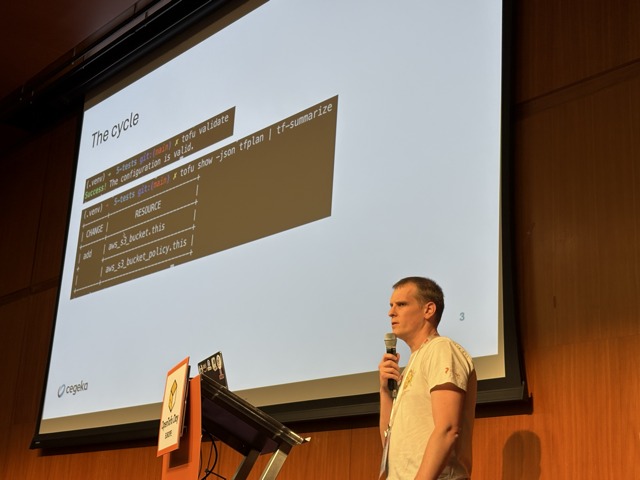
KubeCon | CloudNativeCon Europe, it always feels a bit like coming home. KubeCon | CloudNativeCon Europe 2026 Co-located events aka day-zero I attended Open Sovereign Cloud Day and OpenTofuDay. Open Sovereign Cloud Day As sovereign cloud becomes more and more of a topic in our industry, I was interested in learning more about what’s already available in the cloud native ecosystem. This first talk by Emiel Brok discussed the EU framework for sovereign cloud. It’s a good primer for anyone interested in sovereign cloud and how the EU framework can be used in practice. If you’re working in the EU and want to understand how the framework can be applied to your organisation, this talk is a good starting point. ...

March 26, 2026 · 11 min

If infrastructure as code is code, why don't we test it that way?

Quote: If it hurts, do it more often. Problem When writing Infrastructure as Code (IaC) the typical the cycle goes more or less like this: Write some code Execute the code Validate that it has the desired result by manually checking the result in the target system The result of these actions often looks something like this: You’ve made a silly syntax error on line one The code tries to execute but the backend system returns an error The code executes successfully, but doesn’t configure the target as you expected Everything works as you intended Unfortunately, like any programming, scenario 1-3 occurs vastly more often than scenario 4. ...

February 12, 2026 · 13 min

How to structure infrastructure as code?

Quote: Everything worth doing twice is worth automating. Problem Enterprise cloud environments often consist of 1000s if not 100000s of resources that need to be managed somehow to have a working application for a customer of the enterprise. Operating this many resources is challenging, especially when these environments tend to be subject to constant change, both from the cloud provider side and from the enterprise requirements side. For some time now, Infrastructure as Code (IaC) has been the go-to solution for enterprises to improve their quality of life in operating these large cloud environments. In essence, using automation to improve the throughput a single team can deliver is nothing new. Our datacenter colleagues have been using automation since the early 90s to prevent having to go to the racks to install new software or to repeat that same installation repeatedly over a fleet of 100s of servers in the datacenter. Using automation or infrastructure as code is a no-brainer today for managing even smaller environments. As the famous saying goes everything worth doing twice is worth automating. ...

January 21, 2026 · 15 min

Kubectl 101 to level 9000

This post was originally posted on the Ordina JWorks Blog Mastery isn’t just skill - it’s knowing the right tools and wielding them with precision. Introduction Kubectl is probably one of the more underrated tools in the Kubernetes ecosystem. It’s a tool that every beginner starts with and seasoned experts use to hack something into a cluster, or more accurately, use it to extinguish a fire during an emergency. Because diversity of user profiles using the tool, it packs a lot of goodies under the hood. It can do things as simple as listing all pods in the cluster and showing their status. On the other side of the spectrum are features like kubectl debug. ...

April 8, 2025 · 12 min

Are all managed Kubernetes clusters created equally?

This post was originally posted on the Ordina JWorks Blog Like stars in the night sky, managed Kubernetes services vary in brilliance; not all shine equally, but the right one can illuminate your journey to cloud-native excellence. - ChatGPT 2023 Introduction The use case Comparison Architectural components for Kubernetes setup How managed is the managed service? Out of the box support Conclusion Introduction Kubernetes has been the de-facto standard for cloud-native container orchestration for some years now. Organizations that rely on a microservices architecture, often rely on Kubernetes to be their platform to deploy to. One of the biggest selling points, especially in recent years, is that Kubernetes can provide a very similar user experience for developers across different on-premise and cloud environments. It can provide a common abstraction from the underlying infrastructure through its API. This also allows solutions built on top of Kubernetes to be easily portable across different environments. Or at least, that’s the promise that is being made by Kubernetes platform teams across the industry. ...

October 20, 2023 · 14 min

Back to Terraform

This post was originally posted on the Ordina JWorks Blog “Fail fast” does not imply lack of commitment to a mission or goal, but on the contrary, indicates a willingness to experiment in the process, learn quickly from the results, and make adjustments to better achieve an enhanced customer experience. Introduction Public cloud computing has revolutionized the way organizations approach their IT infrastructure. Rather than investing in and maintaining their hardware and software, businesses can now access computing resources through the internet, on an as-needed basis. This shift towards public cloud adoption has created a demand for new management and deployment approaches, with Infrastructure as Code (IaC) emerging as a critical tool for cloud infrastructure management. ...

June 5, 2023 · 16 min

Keeping up with dependencies like a boss

This post was originally posted on the Ordina JWorks Blog Anything worth doing twice is worth automation. What’s the problem? Lack of features Let’s imagine you need to implement support for a new feature. Let’s imagine that that feature is super easy to implement due to almost native support for the functionality in a library you’re already using. That sounds like a great day, right? You add the code to glue together the API and the library, perform some tests and call it a day. There is just one problem, you didn’t check which version of the dependency you were using and the feature you need is only supported in versions 8.x.x and beyond. You check your pom.xml, only to figure out that you’re on version 6.8.21. Now you have two options, refactor 25% of your codebase to be able to use the new library or 5x your effort for implementing the feature without the support of the library. That doesn’t sound like a great day at the (home-)office, now does it? ...

October 27, 2022 · 10 min

Testing with production data made easy

This post was originally posted on the Ordina JWorks Blog What’s the problem? Testing data migrations is one of the cases where investing in good testing is crucial. Unfortunatly it’s hard to cover all the scenarios and it can be very time consuming to write test code for all of the scenarios you need to cover, especially in a one off migration. Moreover, if the data quality of your production system isn’t 100%, it’s very easy to miss a few scenarios in the analysis, which leads to missed migration scenarios that lead to bugs and incidents. ...

February 14, 2022 · 11 min

Kubernetes clients and dashboards: a comparison

This post was originally posted on the Ordina JWorks Blog Introduction Imagine the following scenario: you’re writing code for your amazing new take-your-bike-to-work platform and you’ve just finished implementing a new feature to allow users to send unicorns to each other. Your CI/CD pipeline has nicely tested, packaged and deployed the updates to your development Kubernetes cluster, you load the URL and are greeted by a very nice error page stating “Oops, my bad, we lost some unicorns”. Clearly, you broke something, somewhere. Most of the time, this means you’ll open up a terminal, run some commands to login into the cluster and start firing two dozen kubectl-commands to figure out which microservice broke and check the logs to figure out where your code has broken. You make some changes to the broken service and push your code to the repository and the CI/CD flow takes over again. ...

August 6, 2020 · 12 min

From 6 weeks to 90 minutes: let Terraform do your work

This post was originally posted on the Ordina JWorks Blog How much infrastructure can you get in 6 weeks time The landscape discussed in this post is used to host a set of applications for a large corporation to assist one of their core products. The end-goal of this platform is to support their target market across Europe. A single environment consists of a namespace on a shared OpenShift cluster, a database and a reverse proxy. In order to spin up a new environment to onboard a new development team the following steps need to be executed: ...

June 2, 2020 · 10 min